
KNUST's Illegal Occupation of Benimasi-Boadi: What You Need to Know Before the October 2026 Trial
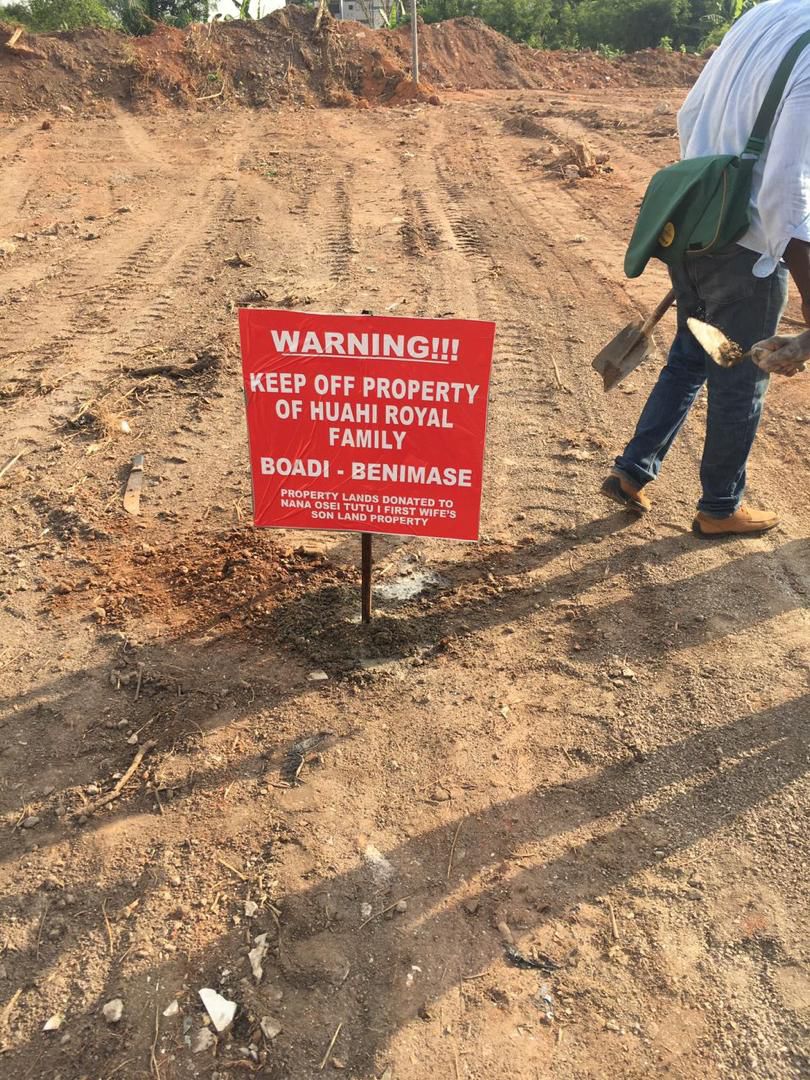
For over a decade, KNUST has been encroaching upon portions of the sacred 1,298.33-acre Benimasi-Boadi ancestral parcel — including the burial grounds of Oheneyere Huahi Yaa Achama Tutuwaa. On 21 October 2026, the Benimasi-Boadi Indigenous community goes to the High Court. Here is everything you need to know.
The Land at the Heart of the Case
Nestled in Ghana's Ashanti Region, the Benimasi-Boadi ancestral parcel covers 1,298.33 acres of land that has belonged to the Huahi Achama Tutuwaa Royal Family since before Ghanaian independence. The land was granted by Asantehene Otumfuo Osei Tutu I — the founder of the Ashanti Empire — to his lawfully wedded spouse, Oheneyere Huahi Yaa Achama Tutuwaa, as a personal inter vivos gift. This makes it indefeasibly Family Land, not Stool Land.
At the heart of this parcel lies a consecrated area that the Family has maintained for generations as an ecological nature reserve and cultural heritage site. This is the sacred burial ground of Oheneyere Huahi Yaa Achama Tutuwaa herself — the matriarch from whom the entire Royal Family's allodial title descends. It is not merely open land. It is a living heritage site, a place of spiritual significance, and the resting place of an ancestor whose legacy is inseparable from the founding of the Ashanti nation.
Exhibit B Series (LVD/FC/ASR/606/2023) — Official GPS Survey Map The map below is the primary cartographic evidence of the Huahi Achama Tutuwaa Royal Family's allodial title. Prepared by Geo Ander Consult and stamped by the Lands Valuation Division, it shows the full 1,298.33-acre Boadi Boundary in red.

Exhibit B Series, LVD/FC/ASR/606/2023. GPS survey map showing the Boadi Boundary (red line) of the Huahi Achama Tutuwaa Royal Family's 1,298.33-acre ancestral parcel in Kumasi, Ashanti Region, Ghana. Prepared by Geo Ander Consult (0246815873). Scale: 0 – 1.1 Miles.
How KNUST Came to Be on the Land
In 1968, the Government of Ghana executed a 60-year Mother Lease with the Kwame Nkrumah University of Science and Technology (KNUST), granting the university use of a portion of land in the Kumasi area for educational purposes. The lease was fixed-term: it commenced on 1 April 1950 and expired by operation of law on 31 March 2010.
Critically, the lease's own description of the demised area named Bomso, Agyigya, Kentinkrono, Anwomaso, Ayeduase, Kyirapatre, Ahinsan, Bebre, and Femusua — conspicuously omitting Boadi and Benimasi. This means the Benimasi-Boadi ancestral lands were never legally part of the demised premises to begin with.
When the lease expired in 2010, KNUST's leasehold interest was automatically extinguished. The land reverted to the Family as the undisputed allodial owner. Despite this, KNUST subsequently obtained a purported "Renewal Lease" from the Government — a legal nullity under the nemo dat quod non habet principle: one cannot give what one does not have. The Government had no subsisting interest to renew.
Exhibit — Lands Commission Search Report The following document extract shows two subleases KNUST granted to private third parties from land it no longer had legal rights over — both executed after the Mother Lease expired on 31 March 2010.

Lands Commission Search Report (LVD/FC/ASR/606/2023): Portion 1 — sublease to Ultimate Gas Limited for 50 years from 1 March 2003 (Doc. No. ASH 05/01/2013, Property No. A.4184). Portion 2 — sublease to Royal Basin Hostel Limited for 40 years from 1 November 2003 to 31 October 2043 (Doc. No. ASH 18/05/2014, Property No. A.4963). Both subleases were granted after KNUST's own lease had expired.
What KNUST Is Actually Doing
KNUST is not merely occupying land under an old lease. The university is actively encroaching upon and selling portions of the Benimasi-Boadi ancestral parcel — specifically the sacred burial grounds and heritage sites — to private third parties. This is happening right now, while the case is before the courts.
The Huahi Achama Tutuwaa Royal Family applied for an interlocutory injunction to halt this construction. On 24 July 2025, the High Court refused the injunction on the grounds that the balance of convenience favoured not stalling a public university's operations. However, the Court ordered KNUST to execute an Undertaking of GH¢1,000,000 (one million Ghana Cedis) at the court registry — payable to the Plaintiff should the action succeed — and directed that the matter proceed to expedited trial.
Construction on the sacred burial grounds has continued unabated since that ruling.
The Legal Case: Suit No. ASH/ADK/HC/E1/177/25
On 25 June 2025, a Writ of Summons was filed in the High Court of Justice (Land Division), Kumasi, bearing Suit No. ASH/ADK/HC/E1/177/25. The Plaintiff is Abusuapanyin Odeneho Odehyee Nanaba Kwabena Badu, suing for and on behalf of the Huahi Achama Tutuwaa Royal Family of Boadi, per his Lawful Attorney Nana Kwesi Osei Bonsu. The Defendants are KNUST (1st Defendant) and the Lands Commission (2nd Defendant).
The case seeks:
- A judicial declaration that the purported Renewal Lease is void ab initio and of no legal effect
- A permanent prohibition order preventing KNUST from any further construction, development, or alienation of any portion of the Boadi lands
- Cancellation of all land records registered in favour of KNUST affecting the Boadi lands
- General and special damages for the desecration of the sacred heritage site and ongoing trespass
- Mesne profits representing the fair value of KNUST's use and occupation during the entire period of trespass
The Family's allodial title has already been judicially affirmed by the KMA Circuit Court (Suit No. A1/73/2023), confirmed by the Lands Commission's own Search Report (Certificate No. KSI. 239/2021), and publicly asserted in a Statutory Declaration published in the Ghanaian Times on 11 November 2021 — without any challenge from KNUST.
The Role of Land Rights Defenders
Land Rights Defenders Inc. is a 501(c)(3) nonprofit organization headquartered in Columbus, Ohio. We are not the legal counsel in this case — the Benimasi-Boadi community is represented by Peter Nii-Adjei Blebo, Esq..
Our role is to support and fund the community's legal fight. We provide financial support for legal costs, conduct international advocacy at forums including the United Nations Permanent Forum on Indigenous Issues (UNPFII), document evidence of encroachment, and amplify the community's story to a global audience.
Land Rights Defenders has delivered formal oral statements at the 23rd Session (April 2024) and 24th Session (April 2025) of the UNPFII in New York, presenting the Benimasi-Boadi case as a global example of institutional land grabbing and calling on member states to uphold Free, Prior and Informed Consent (FPIC) principles.
Why This Case Matters Beyond Ghana
The Benimasi-Boadi v. KNUST case raises questions that resonate far beyond Ghana's borders:
Can a public institution claim land it never lawfully held? KNUST's lease explicitly excluded the Boadi lands. Its continued occupation — and the Government's purported renewal of a lease that had already expired — raises fundamental questions about institutional accountability and the rule of law.
What happens when sacred sites are not protected? The burial grounds of Oheneyere Huahi Yaa Achama Tutuwaa are not merely a legal abstraction. They are a living heritage site. KNUST's construction activities on and around this site constitute not merely a legal trespass but an act of cultural and spiritual desecration — a violation of Articles 10, 25, 26, and 28 of the UN Declaration on the Rights of Indigenous Peoples (UNDRIP).
Who protects communities when the state fails them? The Family's application for an injunction was refused. Construction continues. It is only through international attention, legal persistence, and community solidarity that justice remains possible.
The Trial: 21 October 2026
The substantive trial is confirmed to commence at Ghana's High Court of Justice (Land Division), Kumasi, on 21 October 2026. The case will determine whether KNUST's purported lease is void, whether the Renewal Lease is unconstitutional, and whether KNUST's decades-long occupation and ongoing desecration of the sacred burial grounds constitutes an unlawful trespass requiring full restitution, compensation, and damages.
Land Rights Defenders will be following every development closely and reporting to our supporters and the international community.
How You Can Help
The Benimasi-Boadi community's legal fight is funded entirely through donations to Land Rights Defenders Inc. Every contribution — however large or small — goes directly toward legal costs, evidence documentation, and international advocacy.
You can support the community's fight at landrightsdefenders.org/donate.
You can also follow the case in detail at landrightsdefenders.org/cases/knust, where we maintain a full timeline of proceedings, photographic evidence, and legal documents.
Land Rights Defenders Inc. is a 501(c)(3) nonprofit organization. EIN: 92-3820306. Donations are tax-deductible to the extent permitted by law.
Support the Fight for Land Justice
Your donation funds legal representation, community advocacy, and the protection of ancestral lands for Indigenous communities in Ghana.
Donate NowGet updates on land rights cases, victories, and advocacy news.
Share this article
Sharing takes 2 seconds and helps the community's story reach more people.